

Understanding precise family relationships
People can use terms like cousin quite loosely. However, in genealogical terms, and particularly when working on DNA genealogy, it is vital to understand exactly how people are related and get the terminology right.
If you are going to navigate your way through the complexities of a search for a birth father for instance, you must understand the differences and use the terms appropriately. Otherwise, you may be looking in completely the wrong place for your own position in the family.
First cousins
Starting with the most straightforward, a full first cousin shares a pair of grandparents with us. Two of our four grandparents are also their grandparents. And it follows that one of our parents is a brother or sister to one of their parents. A full brother or sister, a full sibling. And that full sibling is our full aunt or uncle too.
Second cousins
A full second cousin shares a pair of great grandparents with us. Two of our eight great grandparents are also their great grandparents. One of our grandparents is the brother, or sister, of one of their grandparents.
Third cousins
A full third cousin shares a pair of great great grandparents with us. And so on.
One way to remember is by starting with what you know and can remember and building back from there. Your grandparents give you a first cousin. We may even have a first cousin that we can think about when we are working it out. And then we need to add one to each side. A first cousin plus one is a second cousin. And the corresponding grandparent plus one is a great grandparent. A first cousin plus two is a third cousin. And a grandparent plus two is a great great grandparent.
Some people remember that there is one fewer use of the word great than the number of the cousin – so a second cousin shares only a single use of the word great (great grandparents), a third cousin shares two uses of the word great (great great grandparents) and a fourth cousin shares three uses of the word great (great great great grandparents).
You and a regular cousin should always be in the same generation as each other. If you were to draw your family tree on a piece of paper, your shared grandparent (or great grandparent etc) will be at the top and then you would add the next generation underneath, one after another, one for you and one for your cousin and at the end you should sit next to each other, on the same rung of an imaginary ladder.
Cousins once or twice removed
Then we come to the part that has most people scratching their heads. Cousins who are removed. What is that all about? Simply put, they are the parents or children (or grandparents or grandchildren) of your full cousin.
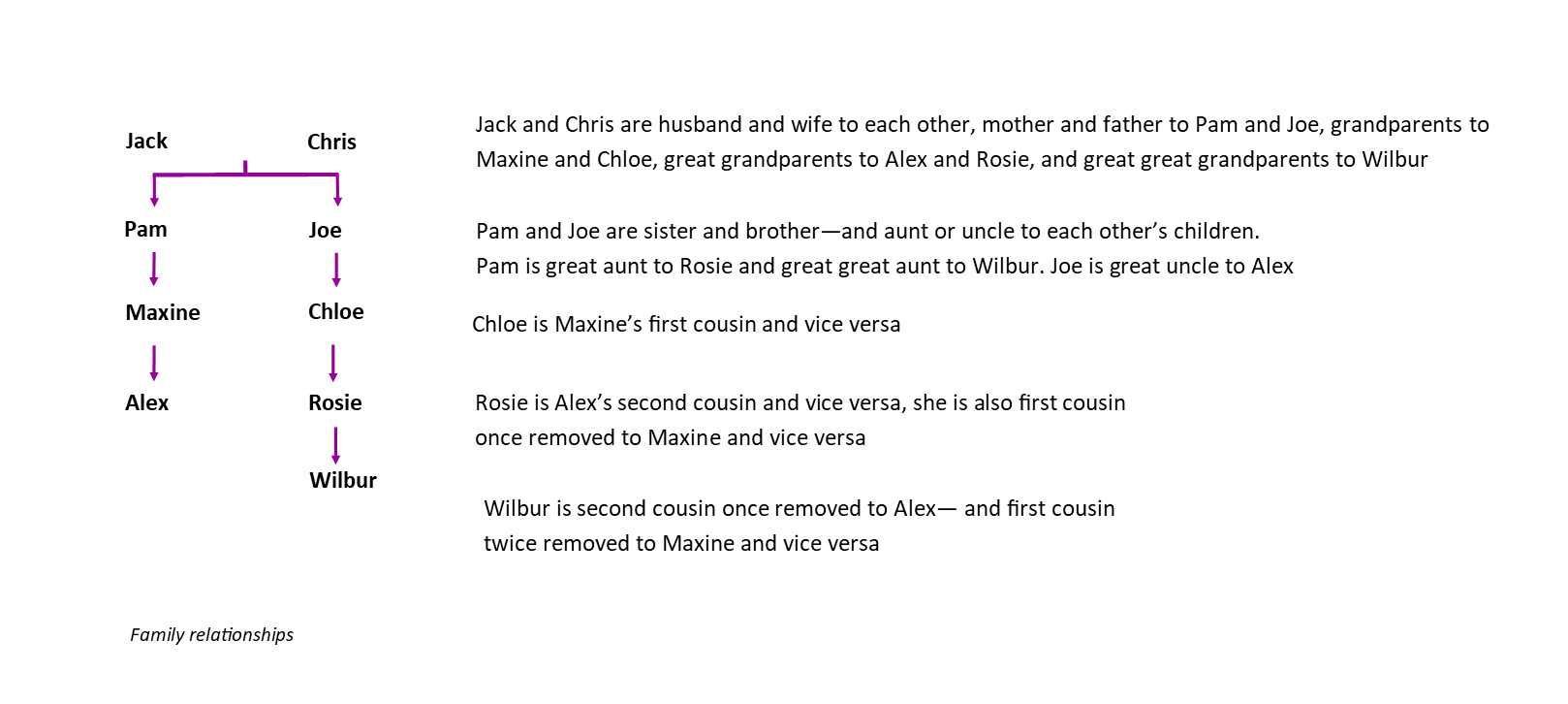
Maxine has a full first cousin Chloe, they share two grandparents, Jack and Chris. Maxine’s mother Pam is sister to Chloe’s father Joe. So far so good.
Now, Chloe has a daughter called Rosie. Rosie is Maxine’s first cousin once removed.
The use of “removed” tells us they are a generation apart, and because it is only one generation, they are once removed. Interestingly, unlike aunts and nieces where they have different titles to each other, with cousins the relationship is called the same thing on both sides. As well as Rosie being Maxine’s first cousin once removed, Maxine is also Rosie’s first cousin once removed.
Rosie had a baby recently, Wilbur. He sits below Rosie on our tree. He and Maxine are two rungs apart, so they are first cousins twice removed. Wilbur’s child, in years to come, will be Maxine’s first cousin three times removed.
Maxine has a son named Alex. He and Rosie are second cousins. They are on the same rung of the ladder, they share a set of great grandparents, Jack and Chris. Their grandparents, Pam and Joe are siblings, and as we know, their parents are first cousins.
Alex and baby Wilbur are second cousins once removed, because Wilbur sits a generation below Rosie, he is one rung away from Alex.
Half cousins and other half relatives
Half relatives share only one ancestor with us, not both. We understand that a half-sister or brother – a half-sibling – shares only one parent with us. Our children and their children will therefore be half first cousins because they share only one grandparent with each other. And the children of our half siblings will be our half nieces and nephews and we will be their half aunt and uncle.
Half relatives extend all the way up the family tree. If your great grandfather had a child with another woman, their descendants will be your half relatives too, and so on.
Now, in terms of family dynamics, you may well wish to describe your half siblings simply as your brother or sister, and drop mention of the half, but in genealogical terms it really does matter.
Maxine has a full sister Louise with whom she would share twice as much DNA as she does with her half brother Robert. If Maxine and Robert were both to take DNA tests, any DNA cousins they shared would be related to their father, the parent they have in common. Whereas Maxine and Louise will have shared cousins who are related to them on their mother’s side and on their father’s side. It is really important with DNA genealogy to understand which branch two people are connected to, so it is vital to understand relationships properly.
Finding my birth father without even a name
Tell me more about DNA and how it works
DNA testing: The practicalities